A penalty spreadsheet can give a very precise result based on false assumptions. The calculation start date, agreed deadline, applicable rate, sectoral exceptions and payment status must be verified before any calculation. Reference rates may change, and contractual conditions cannot be deduced from the client's sector of activity. The useful tool therefore does not provide a “certain” sum by default: it exposes the entries, cites their source, flags incomplete cases and separates an internal estimate from a formal request for payment.
French framework for international readers
The cited Ministry of the Economy and Service Public Entreprendre pages describe payment deadlines and late-payment consequences in France. They are official information sources, not a substitute for the contract or professional review of a disputed claim. A multinational finance team should store the rate source and consultation date with the calculation because a value copied into a template may become stale or may not fit the transaction. Keep the operational alert, accounting entry and amount formally demanded as separate states, each with its owner and evidence.
Control grid “From document to delay calculation”
- proven calculation start date
- contractual deadline read
- integrated payments and credits
- rate sourced on the day of calculation
- visible rounding and formula
- validation before an external claim
Instructions for using the “B2B Prudent Delay Calculator” tool
It calculates only from explicit inputs and preserves their sources. The entries are: outstanding principal, validated calculation start date, calculation date, rate entered, rate source, partial payments. The expected output is a detailed estimate with assumptions, without presenting the estimate as a confirmed amount due. The safeguards are explicit: no long-term pre-filled rates; no date deduced without document; human validation before a claim. When an input is unknown, the tool flags the missing evidence instead of choosing the most favourable outcome.
Official reference for late payment
The Ministry of the Economy and Service Public Entreprendre describes the payment deadlines between professionals, the possibilities of agreed deadlines, late payment penalties and the fixed recovery compensation. The Service Public Entreprendre page is dated and reminds that certain rates may change. These pages constitute a general guide; the contract, the invoice, the nature of the operation and any sectoral rules must be examined. For a calculation on a given day, the value of the rate must come from an official source consulted on that day.
Alerts specific to invoice and collection
- use the rate from the previous year
- count from the date the draft was created
- ignore a partial payment
- present an estimate as the amount definitively due
Scenario: late payment and cash flow
An invoice appears to be overdue in the dashboard. The accountant opens the contract and notices a condition different from the usual model. He checks the date of receipt, enters the partial payment already recorded and consults the official form to check the framework. The calculator displays the assumptions and produces two results: observed principal balance and estimate of accessories to be validated. The manager decides to first send a factual reminder. The calculation, sources and decision are preserved, which allows it to be redone if a payment occurs.
Working method: Prudent B2B delay calculator
1. Identify the invoice, the customer, the transaction and the relevant date of receipt or completion. Keep the document that proves each date. To validate this step, note “proven calculation start date”. The risk to avoid is: using the rate from the previous year.
2. Read the deadline agreed in the contract, the General Terms and Conditions and the invoice, then check that it falls within the applicable framework. Do not apply a standard duration if a special case exists. To validate this step, note “contractual deadline read”. The risk to avoid is: counting from the date of creation of the draft.
3. Determine the due date and the days of delay according to the validated rule. Process partial payments, credit notes, disputes and corrected invoices separately. To validate this step, note “integrated payments and credits”. The risk to avoid is: ignoring a partial payment.
4. Take the rate or formula from the contractual document and the official source on the calculation date. Store the URL and date, not just the value. To validate this step, note “rate sourced on the day of calculation”. The risk to avoid is: presenting an estimate as the amount definitively due.
5. Calculate a reproducible estimate by displaying capital, period, entered rate, rounding and possible compensation as separate lines. To validate this step, note “visible rounding and formula”. The risk to avoid is: using the rate from the previous year.
6. Have the claim and its basis validated before sending. An internal cash flow alert does not automatically become a due debt. To validate this step, note “validation before an external claim”. The risk to avoid is: counting from the date of creation of the draft.
Read the visual “From document to delay calculation”
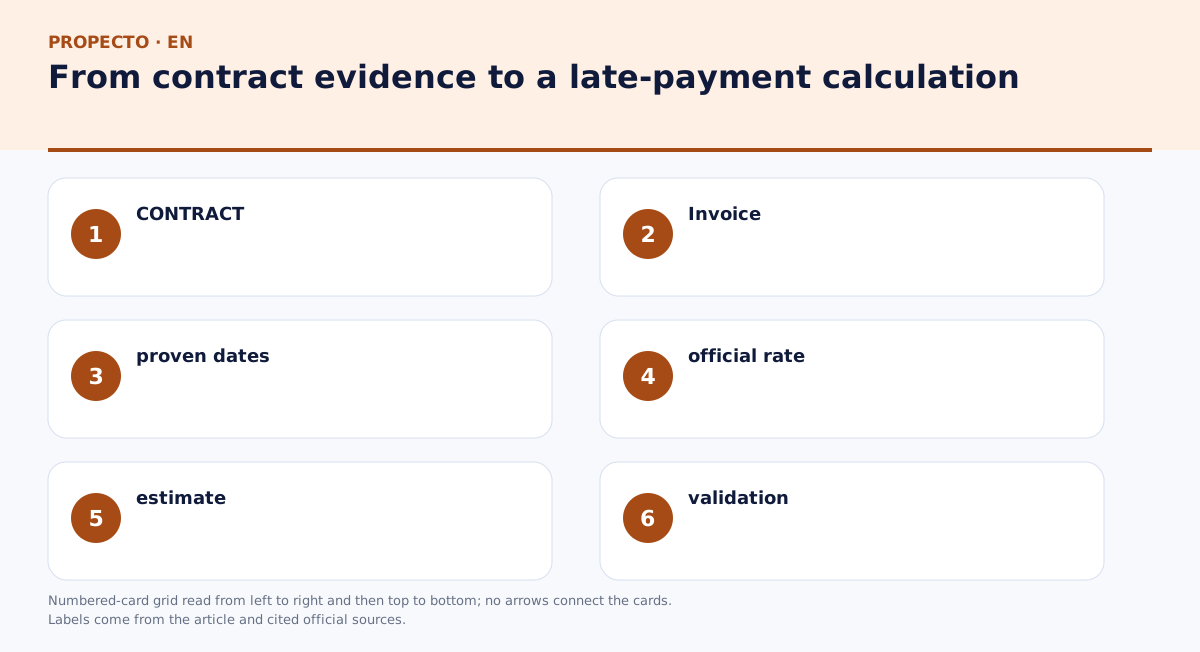
The visual grid uses the review labels “CONTRACT”, “Invoice”, “proven dates”, “official rate”, “estimate” and “validation”. Read the cards from left to right and then from top to bottom; no arrow connects them. They organise the topic’s checkpoints without depicting a decision tree or an automatic chronology, and their meaning does not depend on colour.
Limits of interpretation for late payment
The number of days displayed by software does not prove that the starting point is legally correct. A stored rate may be obsolete. Compensation and penalties should not be added mechanically without checking the applicable conditions. A dispute over the service, a rejected invoice or a credit note can change the file. Finally, the calculator is not a substitute for competent counsel for a disputed claim or international case.
Decision and operational handoff
Trigger an alert when the date calculated from verified documents has passed. Leave the amount of accessories in “to be validated” if the rate, starting point or sectoral framework is not established. For a recovery, distinguish certain facts from calculations. If the customer disputes, freeze the status of the file and send the documents to the competent person before modifying the estimate.
Official sources checked for late payment
- Ministry of the Economy — payment deadlines
- Service Public Entreprendre — deadlines and late payment penalties
Sources and method
- Official source 1 — checked on 2026-08-17.
- Official source 2 — checked on 2026-08-17.
Continue in Propecto
Source éditoriale : Propecto. Date de publication : 2026-08-17. Lorsqu'une donnée vient d'une source externe, sa référence est citée dans le corps de l'article.